I had 3,722 followers and a goal: 5,000. Not for vanity — I want audiences outside DC who actually engage, travel in for shows, and support the work. So instead of guessing, I ran a test. Four days, two reels, $5 a day each. Here's everything it taught me, with the real numbers.
The Set up
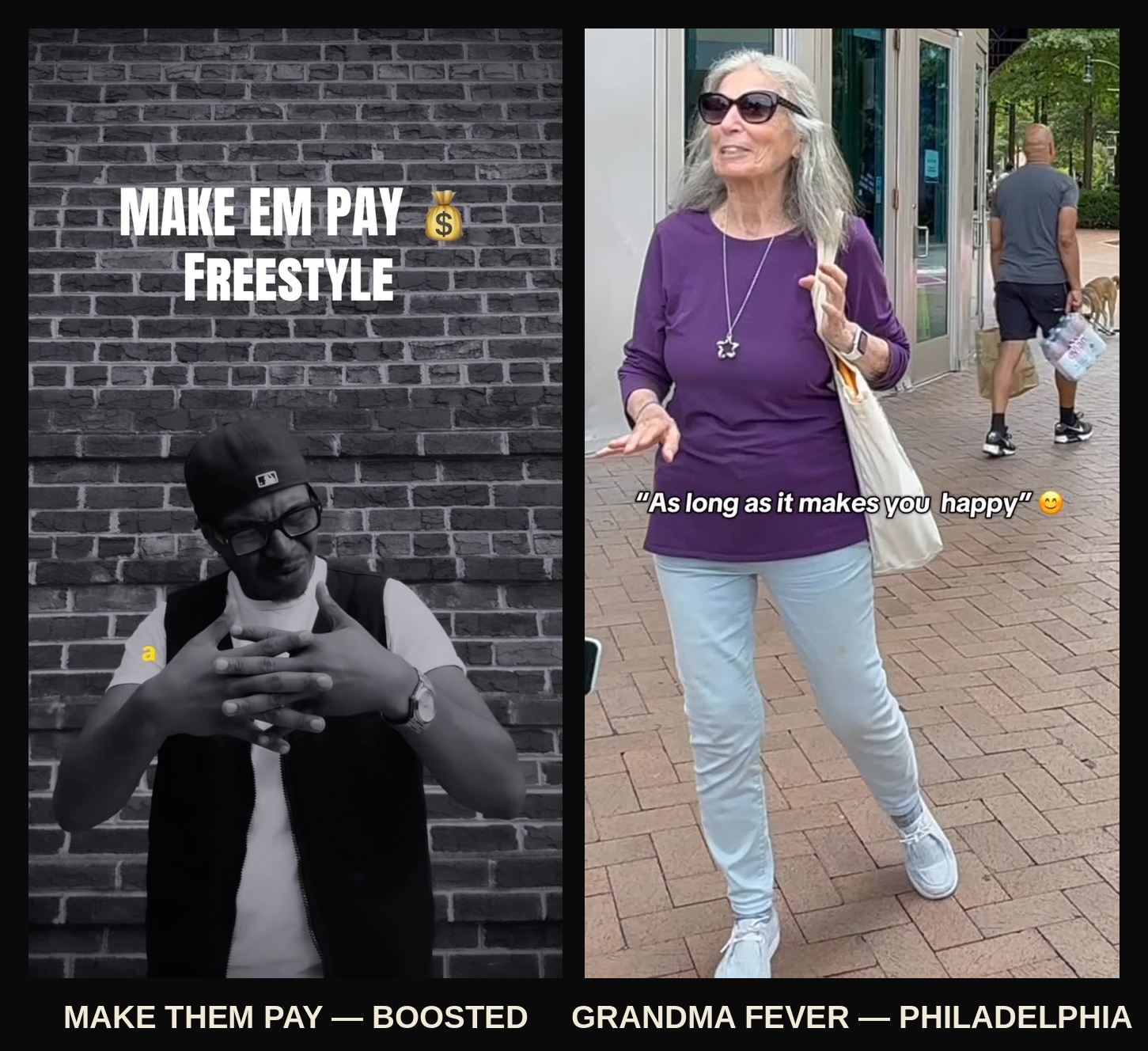
Reel 1 — "Make Them Pay." My current single's energy, shown to a broad audience. This was the control: my sound, my city, no targeting tricks.
Reel 2 — "Grandma Fever." A clip from my song "Fever," aimed at one new market: Philadelphia, age 25–44. Philly was a true test — I had almost no following there. If strangers in a new city followed, the model works anywhere.
The control that cost nothing: a third reel — a freestyle over Timbaland and Drake's "Say Something" — ran organic only, never boosted, so I could see what the ads actually added.
Both ads ran November 17–21 with one job: get people to visit my profile and follow.
The results
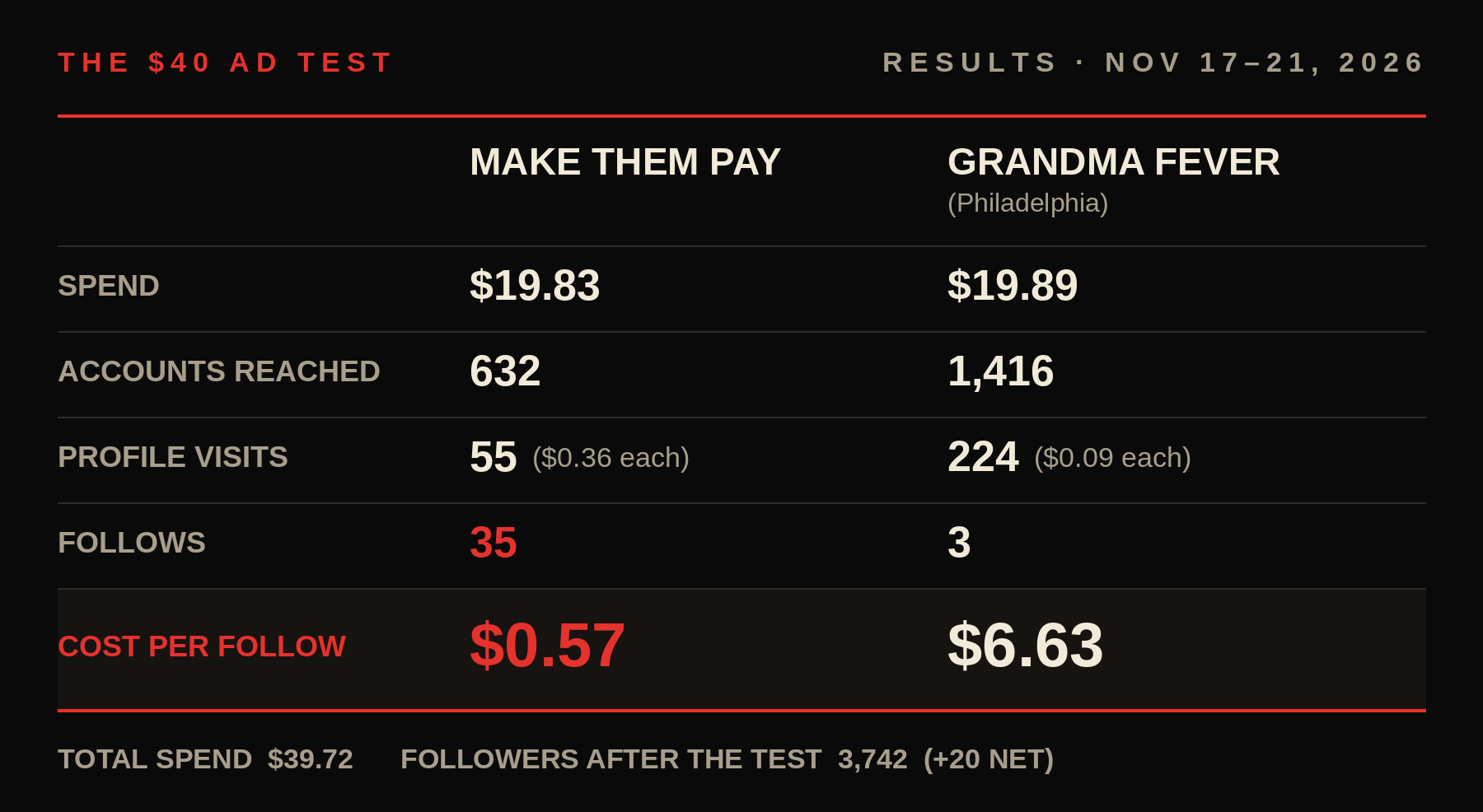
Total spend: $39.72. Final follower count: 3,742 (+20 net — more on that below).
The organic freestyle, for reference: 405 views and the longest average watch time of anything I posted that week (16.9 seconds) — but only 1 follow. People watched. They just didn't move.
Lesson 1: Visits ≠ follows
Grandma Fever won the attention game. It reached more than twice as many people, and its profile visits cost nine cents — a quarter of what Make Them Pay paid. Philadelphia was curious. Philadelphia clicked.
Then Philadelphia left. 224 visits turned into 3 follows — a 1.3% conversion. Make Them Pay's visitors followed at a completely different rate.
The ad buys the click. The profile earns the follow. My bottleneck was never the market — it was the landing. When a stranger hits your page, they decide in seconds: pinned posts, bio, the first row of the grid. Fever sent me a crowd my storefront wasn't dressed for.
Lesson 2: same $20 but 12x smarter
Identical budgets, wildly different returns: $0.57 a follow vs. $6.63 — about a 12x difference. At $5 a day, you can't outspend a weak link in the chain. You find it and fix it. That's the whole game at independent scale: small tests, honest numbers, no ego.
I personally welcomed 37 new followers during the test — and my count only rose by 20. Roughly 17 accounts drifted off in the same window. Net growth is the only number that's real, and it's smaller than the highlight reel. Any artist who only counts arrivals is lying to themselves.
Lesson 3: Count the churn, not the just the arrivals
Here's what the spreadsheet doesn't show. I sent every new follower a welcome DM and replied to their answers with voice messages — because being heard is what turns a follow into a fan. The replies mapped my music's real geography: Detroit. The Philly suburbs. Tennessee. St. Paul. Southern California. Sheffield, Alabama.
Those 37 people now have a name: The Bold — from my line "Fortune Favors The Bold." They hear the music first, they saw the first merch drop first (the Pay The Fee tee, live now at my supply shop), and they're the founding members of the community this whole thing is building toward. The ads didn't just buy followers. They convened a room.
Lesson 4: The test paid for more than follows
What’s Next?
Fix the landing. Pinned story reel, the Fever video, the current drop — so the next crowd Fever sends me lands somewhere dressed for them.
Run the winner in Richmond. Make Them Pay's creative, new market, same $5/day, judged on one number: cost per follow.
Test the new content against the champion. I shot a new piece ("Again & Again") — it goes head-to-head with Make Them Pay at the same budget.
Retry Fever after the profile fix — then take it to the West Coast, where the vibe fits.
The Honest Fine Print
This was a $40 test, not a census. The samples are small, the follow attribution is Instagram's own, and one different week could shade the numbers. But the gap — $0.57 against $6.63 — is not noise. That's a signal you can build a plan on.
If you're an independent artist: you don't need a label's budget to learn what works. You need $40, four days, and the discipline to read what the numbers are actually telling you.
Fortune favors the bold. The data favors the honest.
— Los